AZNPS


Welcome to the Arizona Native Plant Society!

The Arizona Native Plant Society is a statewide nonprofit organization devoted to Arizona's native plants. Its mission is to promote knowledge, appreciation, conservation, and restoration of Arizona native plants and their habitats.

news

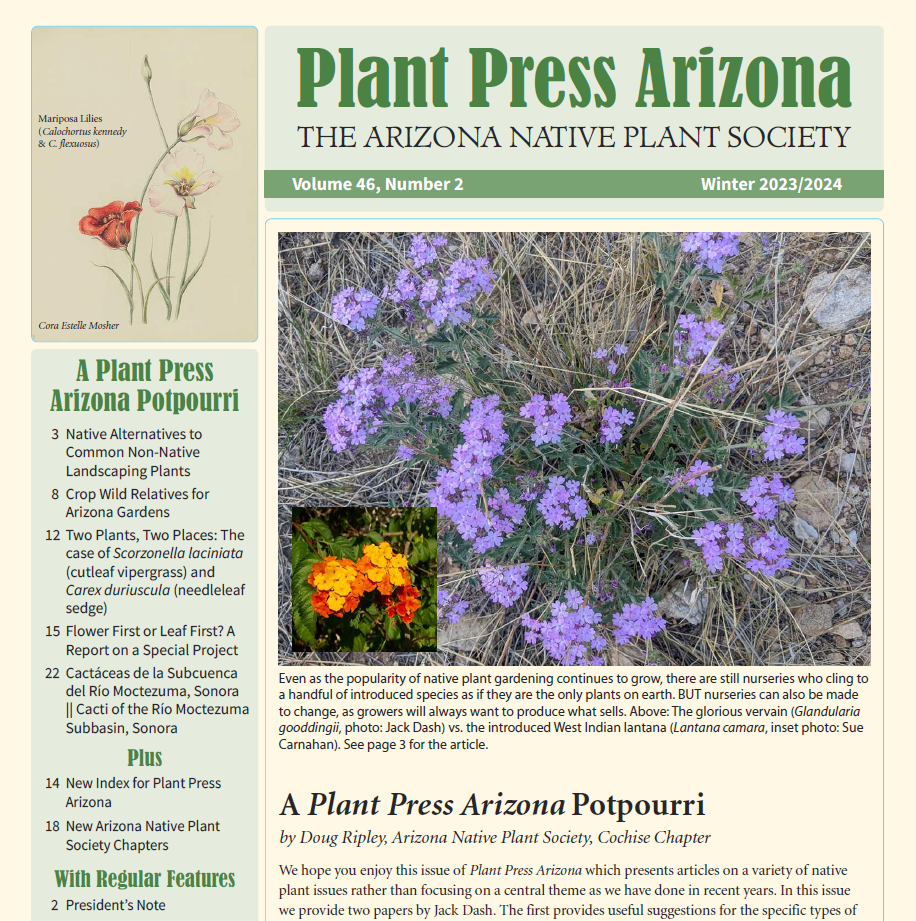
The Spring 2010 edition of PLANT PRESS is now available.

Happenings, the Quarterly Newsletter of AZNPS of the Arizona Native Plant Society - June-August 2010 is now available on-line

Happenings Co-Editor Needed. This very useful little publication that you are reading is in search of a new co-editor to assist Sharon Dyer of the Flagstaff Chapter, who has gamely volunteered for half the job. Duties include soliciting chapter and board news, short articles, and photos four times a year, copy editing what you receive, and plopping the result into this template. Happenings is currently in Word; desktop publishing software would make the task easier and the format more consistent. Interested volunteers should contact AZNPS President Barb Phillips at bagphillips@yahoo.com. For the nitty details, contact me: karolynkendrick49@earthlink.net

NEW! Visit a new website, Tucson Urban Wildlife Walk, to encourage planting native habitats for the native animals.

Southern Arizona Nature Almanac

Floristic almanac: This month-to-month guide to some of the main floristic events in southern Arizona is excerpted or summarized, with permission, from Southern Arizona Nature Almanac, by Roseann Beggy Hanson and Jonathan Hanson (University of Arizona Press, 1996). This charming natural history guide is chock-full of insights, observations, stories, and suggestions for outings into the never-ending wonder of the Sonoran Desert. In Tucson, look for the book at the Audubon Nature Shop, Blue Raven Gallery, Tohono Chul Park, or other booksellers.
SEPTEMBER AT A GLANCE
DESERTSCRUB
•        Snakeweed (Gutierrezia sarothrae), turpentinebush (Ericameria laricifolia), goldeneyes (Viguiera multiflora), desert asters (Machaeranthera spp.), common sunflowers (Helianthus annuus) and telegraph plants (Heterotheca subaxillaris) bloom around the desertscrub and grasslands, especially along roads.
•        Along creeks and washes in desertscrub and grasslands, seep willows (Baccharis salicifolia—not true willows) bloom, and canyon ragweed (Ambrosia ambrosoides) offers its sticky burrs to human socks or mammal fur.
•        Bird migrations are at their peak; see Fauna section for details.
•        Butterflies continue to be abundant from desertscrub into the coniferous forests; in desertscrub look for snouts, common gray and great purple hairstreaks, funereal duskwings and American painted ladies.
•        Desert bighorn sheep continue breeding.
•        Bats and hummingbirds are preparing for migrations in early October, so their numbers and activity increase this month. Both groups include first-year juveniles which must gain strength for their first long flights to wintering grounds.
GRASSLANDS
•        Migrating western kingbirds are one of the most common birds of the southern grasslands, and western meadowlarks return later this month to the grasslands where they will gather in small flocks throughout the winter.
•        Look for flocks of migrating Swainson's hawks, especially in fallow fields or recently burned grasslands where they gorge on grasshoppers, other insects and rodents.
•        Pronghorn antelopes breed this month and next.
•        Bird migrations are at their peak; see Fauna section for details.
•        Variegated fritillary butterflies fly in grasslands in the fall.
OAK WOODLANDS
•        Coral bean (Erythrina flabelliformis) shrubs have woody bean pods six or more inches long and their foliage turns golden yellow.
•        Oak trees may be setting acorns.
•        Flowers include senecio, telegraph plant (Heterotheca subaxillaris) and goldenrod (Solidago sparsiflora).
•        Gatuño (Mimosa dysocarpa) sports delicate pink catkins, washing whole woodland hillsides a glowing pink in southern Pima County.
•        Bird migrations are at their peak; see Fauna section for details.
•        Mule deer and some white-tailed deer may begin to move downward in elevation for the winter; males shed their antler velvet.
•        Butterflies to look for include Nabokov's satyrs, Mormon metalmarks, and Elada and Dymas checkerspots, as well as pipevine swallowtails, cloudless sulphurs, painted ladies and snouts.
PINE-OAK WOODLANDS
•        Flowers still grace trailsides and forest floors, including Lemmon's marigolds (Tagetes lemmoni), Arizona trumpets (Zauschneria latifolia) and bushy tick clover (Desmodium spp.).
•        Common deerbrush (Ceanothus spp.) will bloom this month.
•        Bird migrations are at their peak; see Fauna section for details.
•        Look for Patrobas satyr butterflies this month.
CONIFEROUS FORESTS
•        Most shrubs have gone to seed, including mountain spray (Holodiscus dumosus) and snowberry (Symphoricarpos spp.).
•        A few stoic flowers bloom on, such as Indian paintbrush (Castilleja spp.), primrose (Oenothera spp.) and fleabane (Erigeron spp.).
•        Bird migrations are at their peak; see Fauna section for details.
•        Terloot's white butterflies make a fall flight beginning this month, and American painted ladies are common among the waning thistle stands.
SPECIAL EVENTS
•        Bird migrations are at their peak; Tucson Audubon Society will host many free or small-fee outings this month.
IN THE SKY
•        September 23 is the Autumnal Equinox, when the sun passes directly over the equator. Day and night lengths are approximately equal.
•        The Harvest Moon, the full moon nearest the Autumnal Equinox, occurs late this month or early October. For several days the moon will rise soon after sunset; the extra light helped farmers complete their harvests, thus the name.
•        The constellation Capricornus is best viewed in mid-month in the southeast.
•        The Summer Triangle moves high overhead.
•        Moonless nights are perfect for viewing the wonder of the Milky Way, stretching from the northeast to the southwest.
Print September Almanac...

Support AZNPS through workplace giving

AZNPS has recently joined the Environmental Fund for Arizona (EFAZ), a coalition of non-profit organizations working to keep Arizona healthy and maintain our special quality of environment. This organization was founded to provide funding and bring attention to our vital state environmental non-profit organizations through workplace giving.

Is there a charity giving program in your workplace? If not, why not contact EFAZ to begin the process? Just email or call 480.510.5511. Check the website to learn about EFAZ and all the partner organizations.